Showing posts with label bottle. Show all posts

Wednesday, October 2, 2013

Vomiting and/or Diarrhea

Vomiting and diarrhea viruses are not fun for anyone. Doctors refer to the most common cause of these symptoms as "viral gastroenteritis". Some kids just vomit, some kids just have diarrhea, and the most unlucky have both. 

Most of these illnesses do not need to be treated with medications (antibiotics can make it worse, since they also kill the good bacteria in your tummy), and anti-diarrheal medicines (like Imodium) can be harmful to children. The most important thing is to keep your child HYDRATED (more on that below). If you suspect your child has vomiting or diarrhea from food poisoning or any other type of foreign ingestion, please call poison control 1-800-222-1222, who are free and staffed with physicians 24-7!

How can you tell if your child is starting to get dehydrated?
- their mouth/lips seem dry
- they are urinating (peeing) a little less than usual
- they are thirsty

Now what?
You need to keep your child hydrated!
- A baby can continue to breast feed or take infant formula, if they are just a little dehydrated. If they vomit after every feeding, or are refusing the breast/bottle, then try to hydrate them with an Oral Rehydration Solution, like Pedialyte. Warning: the plain ones taste like salt water, so I suggest getting a few flavored ones and trying them out, to see which ones they will take. If they refuse the bottle completely, you can try feeding them via a syringe or spoon, giving small amounts every 15 minutes.
- A child who is getting electrolytes from food (such as chicken soup, or crackers, even if it's just a little bit) can hydrate with water. If they are not taking in any food, or if they are throwing up the food, please hydrate them with an ELECTROLYTE solution (aka Oral Rehydration Solution, aka ORS). You can buy them at most USA markets (under brand name Pedialyte, or generic versions), you can make your own by mixing 1 liter (5 cups) clean water with 6 level teaspoons (=2 tablespoons) sugar and 1/2 teaspoon salt. You can add a little bit of orange juice or a banana for potassium. Common substitutions are rice water, congee, green coconut water, or mixing gatorade with water (although I do not recommend doing this, since it is hard to get the right balance of electrolytes this way). If your child does not want to drink, try giving them sips every 15-30 minutes, or giving them the ORS/Pedialyte in frozen popsicle form.
- For every age, and everybody in the house, WASH YOUR HANDS A LOT to prevent spread/transmission of the stuff that gets you sick. Teach everyone to wash their hands in warm water, scrubbing for at least 20 seconds (2 rounds of the Happy Birthday song). Try and use real soap and water, instead of no-rinse hand sanitizers, since they do a better job at killing the tummy microbes.

But what if they keep vomiting?
- Let their tummy rest.
- Call your pediatrician, or go to the hospital, if they have signs of dehydration (see more below).
- Ask your pediatrician if your child is old enough and healthy enough for a medication against nausea/vomiting.
- Start with no food, but still give an electrolyte fluid (aka ORS above), for the first 12 hours.
- When they are ready/want to eat, give bland foods (e.g. the popular rice, toast, soup) and avoid foods that are fried, acidic, oily, or contain lactose.

But what if they have icky diarrhea?
- Change the diaper or bring them to the toilet frequently. Use a LOT of diaper cream to keep the area from getting chapped/sore. Put on a zinc cream (like the purple desitin) as if you are icing a cake - this acts as a barrier layer, to prevent acidic poop from sitting on the skin.
- Feed them binding foods, like rice.
- Sometimes the microbes that cause diarrhea, also cause a temporary lactose (the sugar in cow's milk) intolerance, so avoid lactose-containing stuff, like cow's milk and cheese. You usually have to do this for 2-4 weeks after the onset of the illness, until their GI system is back to normal.
- Try a children's probiotic with lactobacillus once per day, such as children's culturelle.

When my patients get sick this way, I often refer them to the great patient resources at UpToDate, such as this one on nausea and vomiting in children:
http://www.uptodate.com/contents/nausea-and-vomiting-in-infants-and-children-beyond-the-basics?detectedLanguage=en&source=search_result&search=patient+information&selectedTitle=7~150&provider=noProvider
or this one on diarrhea in children:
http://www.uptodate.com/contents/acute-diarrhea-in-children-beyond-the-basics?source=see_link

How can you tell if your child is dehydrated enough to warrant intervention (like an urgent care or ER), or at least a call to your pediatrician?
- they are not urinating (peeing)  often enough (every 4-6 hours for a baby, every 6-8 hours for a toddler/child, every 8-12 hours for an older child/adolescent)
- they are crying, but can not make tears
- they are an infant whose fontanel (soft spot on top of the head) is more sunken than usual
- eyes look very sunken

What are some other signs that I should call my pediatrician about, or head over to the local urgent care/ER?
- persistent high fever (above 102.5 F)
- any fever in an baby younger than 3 months old
- severe abdominal (tummy) pain
- abdominal pain that moves to the lower right side
- lethargy or decreased responsiveness
- bloody (red or black) or bright green (like pea soup) vomit or diarrhea
- diarrhea not improving after 1 week

Soon your baby will be back to enjoying (throwing) his food (c) 2013
The good news is that the gastroenteritis season is almost over, so hang in there. However, we are getting into cough and cold season, so see my August 2012 post for tips on that:
http://mommedicine.blogspot.com/2012/08/coughs-colds-and-croup.html)


Thursday, September 15, 2011

Tips for Stopping Bad Habits (giving up the bottle, paci, and thumb)


When should you quit?

The bottle should be the first thing to give up, between 12 and 18 months. Continuing to give a bottle at bedtime increases the child’s risk for ear infections and dental problems. Your toddler should be drinking 16oz-24oz (2-3 cups) of milk per day. Less than 16oz does not give them enough calcium and vitamin D, but too much milk can cause iron deficiency anemia and fill up your child, preventing them from eating other nutritious things.

The pacifier is usually the next thing to give up, between 1 and 3 years old. It is important to stop in order to prevent ear infections and poor teeth/ jaw alignment. The pacifier has also been blamed in some for lisps, and delayed language development (the child may use it as an excuse to not speak properly).

Thumb sucking is the hardest to stop, and most pediatricians recommend no intervention until age 4, since most kids will stop sucking their thumb on their own before then.

Sleeping solely in the child’s own bed is a very personal decision, as there is nothing medically wrong with sharing the bed with a toddler (unlike in infancy, when you must be careful of how you co-sleep to prevent SIDS). However, teaching them to sleep on their own is a way to help children learn to self-comfort, as well as providing the whole family with better sleep.

How Do We Stop?

Some tip for breaking any habit:

  (1) Decide if you want to stop the behavior completely all at once (“cold turkey”), or wean it off gradually (usually by limiting the activity to bed time).
 (2) Do not turn it into a confrontation with the child. Let them know you are here to help them stop the habit, and why you want them to stop.
(3)     Have them come up with alternative methods of self-soothing with you. Ask them, “What can you do instead?” Guide them to choosing something that is reasonable.
(4)  Point out that their older siblings, friends, even characters that they like, do not use a pacifier/ suck their thumb/etc… and let them know “big kids” don’t do it. Example while watching Dora The Explorer, “Wow, look what a big girl Dora is! She and Boots have all these adventures and she doesn’t suck her thumb, even when Swiper comes.” Point out how much your child has changed/ grown in other ways, and let them know how proud you are of them.
(5)  Do not prohibit them from self-soothing in high anxiety situations, or when there is a big change (such as a new sibling being born or a parent going on a business trip).
(6)  Make sure they are aware they are doing it (by pointing it out in a helpful, positive way), and distract them with something else to do.
(7) Give them an acceptable substitute, such as a blanky/lovey, small stuffed animal, special new cup, or small cloth square to keep in their pocket (this last item can be rubbed by the child with fingers in pocket, especially when substituting for thumb-sucking or nail biting). Make sure the child is involved in choosing the new item, and knows why. If you decide on a lovey that your child gets attached to, make sure you have 3 identical ones in rotation, so one can always be in the wash, one in use, and one back-up.
(8) Reward charts can be helpful for children who are age 3 and above (the older, the better). This is a sheet with calendar spaces for 2 to 4 weeks, with the last space with a pre-determined prize, such as a trip to a special place (e.g. Disneyland), or special new toy. The child puts a sticker or X in the space every day that they don’t do the habit, in some cases only consecutive days of not doing the habit are allowed to be charted.

The bottle is the most important thing to give up, for your child’s health. At 12-18 months transition to a sippy cup, then around 21 months transition to a regular cup for meals and snacks (sippy and straw cups are fine to use when going out). Start by holding the cup for the child, and teaching them to hold it themselves with very small amounts of water in it (to reduce spills/ clean up). You can also give gradually less milk in the bottle until there is none (e.g. decrease the amount of milk in it by 2oz each day).

The pacifier is usually a difficult transition because of age, and the new toddler’s desire for independence. In addition to the general tips above, you can also try the following: (1) Give it away to a baby (not the child’s new sibling, since that can lead to jealousy), or a favorite character (such as on a trip to Disneyland). Make sure the child participates in the giving away ceremony. (2) Have the pacifier sewn into a stuffed animal (like at one of the Build a Bear workshops), then the child can sleep with the stuffed animal. (3) Cut a hole in the pacifier, so the sucking action stops working. (4)  Make a necklace out of the pacifiers, and hang it on their crib. Let the child know if they don’t use the pacifiers for a certain amount of time they get a pre-determined reward. This works well with older children, with a reward chart.
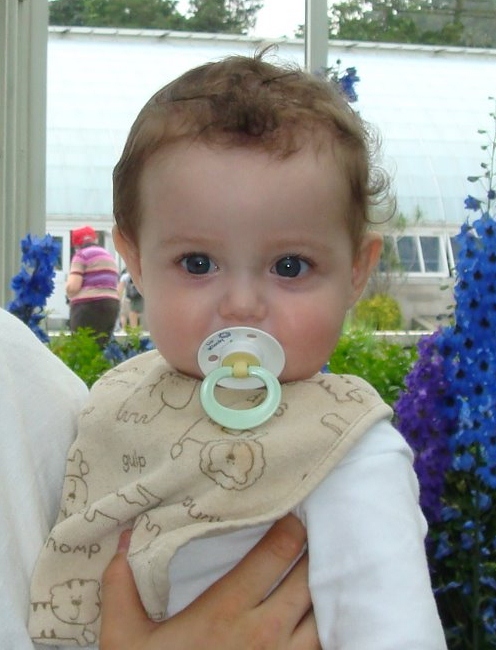
[Photo of my son while still happily sucking his pacifier at 9 months old (c) ]

Thumb sucking is the hardest habit to break, since you can’t take away their fingers. For this reason, and since most toddlers stop thumb sucking on their own, it is recommended to wait until the child is 4 years old before intervening. Peer pressure at that age also helps them try to stop (at least in public), and they respond better to reasoning. First try all of the above tips in the general section, especially pointing out when they do it, distracting them, giving them a substitute, and reward charts. In addition, you can provide a barrier by tying socks or mittens on their hands (there is no need to spend money on the fancy devices that do the same thing). Some girls respond to having a manicure. Other children are better reminded to stop by placing bandaids on the thumbs. I think bitter nail polish should only be used as a last resort, since this seems like a punishment to me, and I try to keep the experience positive, letting the child know that their parent is there to help them. The key at this age is that they need to want to stop, which means a lot of discussion in the house about why it is important to stop.

Bedtime is usually a big struggle with toddlers, so each family needs to decide for themselves how they want to handle it (pick and choose your battles). If the parents want the bed to themselves, or simply want the toddler to sleep on his own, the younger you start with sleep training, the easier it is. If your toddler is getting up in the middle of the night and coming to your bed, you can firmly, but simply, bring them back to bed each time. A music box or sleep sheep (white-noise maker) that they associate with going to sleep can really help (be sure to use this at regular bedtime and naptime as well). Another option is allowing them to sleep in your room, but not in your bed, so they feel close to the parent, but not comfortable. You can put a simple mattress down on the floor, or even just a blanket. This minimizes the parents waking up, which can be a big help to everyone. Another option which some people recommend, but which I never use, because it just seems cruel and unsafe, is to put a baby gate or lock on the child’s bedroom door, so that they cannot open it and leave their room at night. Whatever method you choose, or even if you choose to let the child sleep in your bed, just try to provide minimal attention when they wake up, since you do not want to reward them for getting up in the middle of the night, and everyone needs a good night sleep.