Showing posts with label medicine. Show all posts

Monday, January 5, 2015

Wheezing: Tips for Kids Using Inhalers

Children with wheezing, reactive airways, asthma, bronchospasm, or difficulty breathing are often prescribed a metered dose inhaler with a spacer device.

There are different kinds of metered dose inhalers (“MDI”):
1)      A “rescue inhaler” contains Albuterol or Levalbuterol, which opens up the lungs and reduces inflammation for quick relief. Brand names include Ventolin, ProAir, Proventil, or Xopenex. These are equivalent to putting 1 vial of Albuterol or Xopenex in a nebulizer and sitting with the mask on your child for 15 minutes. These are usually used on an as-needed basis, up to every 4 hours. If your child needs to use this every 4 hours for more than 24 hours, needs it more often than every 4 hours, or needs this more than twice every week, please call your pediatrician.
2)      Some inhalers are used to prevent asthma, wheezing, and breathing trouble. These are only effective when used every day. They are not used for fast-acting relief of an acute breathing difficulty, but may help when used during cold or allergy season, or if started right at the beginning of an asthma exacerbation or when a child is exposed to known triggers. Brand names of some of these medicines include Flovent, Qvar, Symbicort, Dullera or Advair. Flovent and Qvar are like using the Pulmicort/Budesonide in the nebulizer. Please discuss if and when you should use these with your physician.
3)      There are also inhalers that contain powder or are not used with a spacer. Some brand names are: Maxair autohaler, Asmanex Twisthaler, or Pulmicort Flexhaler. None of these need a spacer to work effectively, but these are only for older children.

Please see the “Asthma Education For Kids” playlist from BoosterShotComics on YouTube, especially episode #1: “Iggy & The Inhalers” to better understand the roles of different medications used for wheezing or asthma. Episode 4 explains how to use a spacer with mouthpiece.

There are 4 main brands of spacers. They may be cheaper online than from a pharmacy, but always require a prescription.

1)      Aerochamber with flow-vu. This brand is a clear tube with colored ends and teddy bears on the side. It has a two-way valve (to get the medicine in and air out) and is anti-static (so the kid can inhale all of the medicine and it won’t stick to the sides). The flow-vu allows you to see when a child gets a breath with a good seal. There is a small orange one for infants, yellow medium one for age 1-5 years old, blue one with mask for older children that still need a mask, and blue one with mouth-piece for older kids that can seal their lips around it instead of having to use a mask (more comfortable, kids can usually start doing this around age 6).
2)      Vortex Non-Electrostatic Valved Holding Chamber. This device also has a two-way valve and is anti-static. It is metal, so it is more durable and machine-washable. It comes in 1 size with different sized masks that fit on the end. This has the advantage of only needing one device as the child grows older (you just switch the mask on the end, not the whole device).
3)      Optichamber. The original device is a plastic tube with 1-way valve that most pharmacies try to give our patients. Some versions are NOT anti-static, therefore much of the medicine sticks to the plastic, instead of being inhaled by the child. The single valve can make some children feel suffocated when breathing into the mask. I do NOT recommend this device. However, there is now an Optichamber Diamond version, which is anti-static, has a 2-way valve, and can be used comfortably. It comes with different size masks or a mouth piece, all clear, and very soft.
4)      InspiraChamber. This is a clear, anti-static, valved chamber, with purple ends. It offers very soft masks with a special place in the small mask to fit a pacifier, to calm the child while they inhale. It also has a flap that moves, so you can see if the child is taking a breath with a good seal and getting the medicine. It will be available after February 2015.

How to Use Your Inhaler:

Before using a new inhaler for the first time, put it into the spacer and press it 15 times to prime the device (e.g. makes sure the medicine is coming out in an even dose, and not just the propellent).
my son playing with his inhaler and spacer a few years ago (C) 2015

To use a spacer with a mask:
  • Shake the inhaler before each use.
  • Put the inhaler mouthpiece into the spacer.
  • Hold the mask over your child's nose and mouth and create a good seal. Holding your fingers like the letter C can help. If you’re using a device with flow-vu, you should see the flap move with each breath the child takes. Otherwise look at the child’s chest to count breaths.
  • Press the inhaler.
  • Have your child breath in and out six times (about 30 seconds).
  • Remove the mask and let your child breath normally for a minute.
  • Repeat if more than one puff was prescribed (most inhalers need 2 puffs per dose).
While your younger child may not like the spacer and mask being held over his mouth and nose, it will go much quicker than using a nebulizer. Let the child play with it and practice putting it on stuffed animals or family members to make them comfortable. Some children will allow you to use it if they get to be the ones to hold it or press the inhaler (just make sure the seal is tight over their face so they get all of the medicine).

To use a spacer with mouthpiece (older children and adults):
  • Shake the inhaler before each use.
  • Put the inhaler into the spacer.
  • Have your child seal their lips around the mouthpiece and exhale.
  • Press the inhaler.
  • Have your child breath the medicine in and hold their breath for about 30 seconds. If they can’t hold their breath, they can take another breath or 2 in to get more medicine from that puff (any extra medicine should be sitting in the chamber).
  • Take the spacer out of their mouth and have the child breath normally for a minute.
  • Repeat if more than one puff was prescribed (most inhalers need 2 puffs per dose).
Keep in mind that while many experts believe that an MDI with a spacer is as good as, or better than, a nebulized treatment, some parents prefer a nebulizer, and that is okay.

If you are not sure if your child is actually wheezing, or what they have, this blog from Dr. Stuppy can help, with descriptions of different kinds of coughs and breathing, along with youtube video links.

If your child does NOT have asthma, reactive airway disease, wheezing, bronchospasm, or difficulty breathing, my post on Coughs, Colds and Croup may be more helpful.

Please note that this guide is NOT intended to diagnose or treat any illness or condition. Always speak to your own physician for advice. 

Tuesday, July 29, 2014

Private Parts: Talking to Your Child About Their Bodies, Behavior, and Babies

It is important to start speaking with your children about their bodies and behavior at an early age. If you create an open dialogue, without shame, your children will feel free to bring you their questions throughout their lives. This is often an uncomfortable topic for parents, so I have created a list of books and resources to help you get through it (scroll down). I also encourage you to discuss any questions you have on the topic with your child's pediatrician (we are always here to help!).

Some tips:
  • Watch out for everyday opportunities to teach your child about privacy and hygiene.
  • Encourage your child to ask you questions, to learn that they can feel comfortable coming to you with their thoughts.
  • Try to be calm and open about the topic (pay attention to your body language and tone of voice).
  • Give simple and short answers.
  • Make sure your answers are age appropriate.
  • Young children take everything you say literally, so avoid metaphors.
  • Use anatomically correct terms for their body parts (i.e. penis and vulva, not "weewee")
  • Avoid shame and ridicule.
  • Become closer to your child by showing them that you accept & support their feelings.
  • Set rational and consistent limits.

Here is a great blogpost by Dr. Claire McCarthy on getting started with the conversation: "6 Tips For Talking To Your Kids About Sex."

I also recommend looking at the website "Empowering Our Children," which is designed to teach parents how to protect their children from sexual abuse.

The "ScaryMommy" website has a good post on what these conversations with toddlers may look like.

My Book Recommendations:

For parents to read overall:

  • “Everything You NEVER Wanted Your Kids To Know About Sex (but were afraid they’d ask)” by Dr. Justin Richardson & Dr. Mark Schuster
This is the best book for parents to read on the subject. It tackles every sexual stage of development from infancy (yup, some babies masturbate) through adolescence, as well as age-less topics, such as homosexuality. I recommend starting to read this book when your child is young, although it’s never too late to learn.

For parents to read on tough questions kids ask in general (not on sex):

  • “The Top 50 Questions Kids Ask” by Dr. Susan Bartell
  • “Questions Children Ask & How To Answer Them” by Dr. Miriam Stoppard
These books cover tough questions that kids bring up in general, like spirituality, fear, and growing up. The first book is good for uncovering the real meaning behind some questions, and figuring out the best way to respond.

Books to read with your children (or for them to read by themselves), by age group:

Toddlers & Pre-Schoolers:

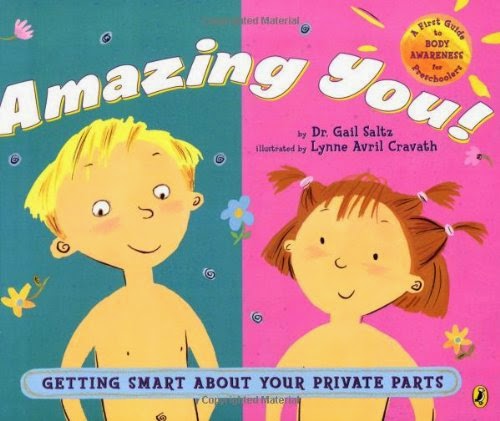
  • “Amazing You: Getting Smart About Your Private Parts” by Dr. Gail Saltz
My favorite overall book for toddlers. Teaches basic anatomy, privacy, and even how babies are born.


  • “When You Were Inside Mommy” by Joanna Cole
A very simple book on pregnancy and birth to read to young children. No lies (e.g the stork), but no anatomy or private parts mentioned either.

  • “What Makes a Baby?” by Cory Silverberg
This book is great for families that conceived via IVF, adoption, surrogacy, or traditional means. It talks about sperm, egg, uterus, and birth, but each as its own thing, and at the end it asks, “Who was waiting for you to be born?” Technically accurate, but simple, with cartoonish illustrations.

  • “Where Did I Come From?” by Peter Mayle
This is the classic “how babies are made” children’s book, but take a look through this book before buying it, as it is may be too explicit for some families (see the anecdote at the end of this blog post).

  • “My Body Belongs To Me” by Jill Starishevsky
This book discusses inappropriate touching/abuse. It does not discuss development or how babies are made.


School Age Children:

  • “It’s So Amazing! A Book About Eggs, Sperm, Birth, Babies, and Families” by Robie Harris
Covers all of the basics, including proper anatomy, mostly with diagrams, and a little cartoon guidebird.


Tweens:

  •  “It’s Perfectly Normal: Changing Bodies, Growing Up, Sex, and Sexual Health” by Robie Harris & Michael Emberley
Very similar to the school-age version by Harris (above), but with more words, less illustrations, and more details.

  • “The Care & Keeping of YOU: The Body Book for Girls” by American Girl
My tween patients report that they love this book. It goes over what to expect in puberty and how to take care of girls’ changing bodies. This book includes discussions on hygiene and how to use menstrual products. There is a new version with the number 2 on it, and a version for boys.

Dr. Stuppy and the Mighty Girl website also have good posts on discussing puberty.

An Anecdote:

When I was 3 years old, my mother (who is a pediatrician as well) read me the book "Where Did I Come From?" I went to my religious nursery school and proceeded to tell everyone, "I was the fastest sperm!" Some of the other parents were not happy when their own children went home and repeated the same thing to them. My mom got a stern 'talking to' by the school. We still laugh about it, to this day. The moral of the story? Teach your children about their bodies and development before anyone else does, or you may not be happy with what they learn ;)


For newer blog posts on the subject, as they come out, you can also follow my pinterest boards on Teenagers, Parenting, and Kids' Health.

Wednesday, October 2, 2013

Vomiting and/or Diarrhea

Vomiting and diarrhea viruses are not fun for anyone. Doctors refer to the most common cause of these symptoms as "viral gastroenteritis". Some kids just vomit, some kids just have diarrhea, and the most unlucky have both. 

Most of these illnesses do not need to be treated with medications (antibiotics can make it worse, since they also kill the good bacteria in your tummy), and anti-diarrheal medicines (like Imodium) can be harmful to children. The most important thing is to keep your child HYDRATED (more on that below). If you suspect your child has vomiting or diarrhea from food poisoning or any other type of foreign ingestion, please call poison control 1-800-222-1222, who are free and staffed with physicians 24-7!

How can you tell if your child is starting to get dehydrated?
- their mouth/lips seem dry
- they are urinating (peeing) a little less than usual
- they are thirsty

Now what?
You need to keep your child hydrated!
- A baby can continue to breast feed or take infant formula, if they are just a little dehydrated. If they vomit after every feeding, or are refusing the breast/bottle, then try to hydrate them with an Oral Rehydration Solution, like Pedialyte. Warning: the plain ones taste like salt water, so I suggest getting a few flavored ones and trying them out, to see which ones they will take. If they refuse the bottle completely, you can try feeding them via a syringe or spoon, giving small amounts every 15 minutes.
- A child who is getting electrolytes from food (such as chicken soup, or crackers, even if it's just a little bit) can hydrate with water. If they are not taking in any food, or if they are throwing up the food, please hydrate them with an ELECTROLYTE solution (aka Oral Rehydration Solution, aka ORS). You can buy them at most USA markets (under brand name Pedialyte, or generic versions), you can make your own by mixing 1 liter (5 cups) clean water with 6 level teaspoons (=2 tablespoons) sugar and 1/2 teaspoon salt. You can add a little bit of orange juice or a banana for potassium. Common substitutions are rice water, congee, green coconut water, or mixing gatorade with water (although I do not recommend doing this, since it is hard to get the right balance of electrolytes this way). If your child does not want to drink, try giving them sips every 15-30 minutes, or giving them the ORS/Pedialyte in frozen popsicle form.
- For every age, and everybody in the house, WASH YOUR HANDS A LOT to prevent spread/transmission of the stuff that gets you sick. Teach everyone to wash their hands in warm water, scrubbing for at least 20 seconds (2 rounds of the Happy Birthday song). Try and use real soap and water, instead of no-rinse hand sanitizers, since they do a better job at killing the tummy microbes.

But what if they keep vomiting?
- Let their tummy rest.
- Call your pediatrician, or go to the hospital, if they have signs of dehydration (see more below).
- Ask your pediatrician if your child is old enough and healthy enough for a medication against nausea/vomiting.
- Start with no food, but still give an electrolyte fluid (aka ORS above), for the first 12 hours.
- When they are ready/want to eat, give bland foods (e.g. the popular rice, toast, soup) and avoid foods that are fried, acidic, oily, or contain lactose.

But what if they have icky diarrhea?
- Change the diaper or bring them to the toilet frequently. Use a LOT of diaper cream to keep the area from getting chapped/sore. Put on a zinc cream (like the purple desitin) as if you are icing a cake - this acts as a barrier layer, to prevent acidic poop from sitting on the skin.
- Feed them binding foods, like rice.
- Sometimes the microbes that cause diarrhea, also cause a temporary lactose (the sugar in cow's milk) intolerance, so avoid lactose-containing stuff, like cow's milk and cheese. You usually have to do this for 2-4 weeks after the onset of the illness, until their GI system is back to normal.
- Try a children's probiotic with lactobacillus once per day, such as children's culturelle.

When my patients get sick this way, I often refer them to the great patient resources at UpToDate, such as this one on nausea and vomiting in children:
http://www.uptodate.com/contents/nausea-and-vomiting-in-infants-and-children-beyond-the-basics?detectedLanguage=en&source=search_result&search=patient+information&selectedTitle=7~150&provider=noProvider
or this one on diarrhea in children:
http://www.uptodate.com/contents/acute-diarrhea-in-children-beyond-the-basics?source=see_link

How can you tell if your child is dehydrated enough to warrant intervention (like an urgent care or ER), or at least a call to your pediatrician?
- they are not urinating (peeing)  often enough (every 4-6 hours for a baby, every 6-8 hours for a toddler/child, every 8-12 hours for an older child/adolescent)
- they are crying, but can not make tears
- they are an infant whose fontanel (soft spot on top of the head) is more sunken than usual
- eyes look very sunken

What are some other signs that I should call my pediatrician about, or head over to the local urgent care/ER?
- persistent high fever (above 102.5 F)
- any fever in an baby younger than 3 months old
- severe abdominal (tummy) pain
- abdominal pain that moves to the lower right side
- lethargy or decreased responsiveness
- bloody (red or black) or bright green (like pea soup) vomit or diarrhea
- diarrhea not improving after 1 week

Soon your baby will be back to enjoying (throwing) his food (c) 2013
The good news is that the gastroenteritis season is almost over, so hang in there. However, we are getting into cough and cold season, so see my August 2012 post for tips on that:
http://mommedicine.blogspot.com/2012/08/coughs-colds-and-croup.html)


Friday, March 15, 2013

Immunization Information

There are a lot of great sites out in the world wide web that have information to help parents make an informed choice about vaccinations; however, unfortunately, there are also a lot of bogus sites that rely on anecdotes to promote myths, so I am including just a few links to help people find scientifically accurate information on vaccines:

My favorite book for vaccine information is "Vaccines and Your Child: Separating Fact from Fiction" by Paul Offit. It is short and covers all of the questions that parents frequently ask about immunizations. Here is the link to it on amazon:
http://www.amazon.com/Vaccines-Your-Child-Separating-Fiction/dp/0231153074/ref=sr_1_1?ie=UTF8&qid=1363372723&sr=8-1&keywords=offit

The Children's Hospital of Philadelphia has a wonderful Vaccine Education Center, which covers the same material as in Dr Offit's book (above), as well as videos, FAQ pages, and more.
http://www.chop.edu/service/vaccine-education-center/home.html
This is a great place to start if you want information on aluminum (which your child gets more of in breast milk than vaccines), formaldehyde (which our own bodies produce, and is also found naturally in things like pears), and other vaccine ingredients.
http://www.chop.edu/service/vaccine-education-center/vaccine-safety/vaccine-ingredients/

A great place to go once your child (or you) has gotten a vaccine and you have questions about it, or if you know of a specific vaccine that is coming up for your child, is the USA's Center for Disease Control. They put out "Vaccine Information Statements" on each vaccine that is routinely given in the USA:
http://www.cdc.gov/vaccines/pubs/vis/
They are also the best site to check out what vaccines you need for foreign travel:
http://wwwnc.cdc.gov/travel/page/vaccinations.htm
Remember to check out the site and make an appointment at a travel clinic at least 6 months before traveling to areas which may have diseases that are not in your home country.
The USA government also has a general vaccination information site:
http://www.vaccines.gov/

The U.S.A. has a vaccine adverse events reporting system (VAERS), but it allows anyone to "report" anything they likem without being the least bit accurate. Check out this great post on the subject:
http://momswhovax.blogspot.com/2011/10/incredible-hulk-vaccine-side-effect-or.html

If you have specific concerns about vaccines, or have heard some of the myths, please see the skeptcial raptor's blog, which covers each of the myths:
http://www.skepticalraptor.com/vaccine.html
Especially this post:
http://www.skepticalraptor.com/skepticalraptorblog.php/mmr-vaccines-do-not-cause-autism/

If you want to see what happens when a child does NOT get vaccines, check out Shot By Shot's videos:
http://shotbyshot.org/

If you are a visual learner and only have 5 minutes, check out this beautiful infographic on vaccines:
http://www.vaccinews.net/2012/09/infographic-a-brief-history-of-the-fight-to-save-lives/#
If you have more than 5 minutes, Vaccinews's blog is also a good site to learn more about vaccines.

A cute and very short blog post about the chicken pox vaccine:
http://mytwohats.com/2012/08/20/why-vaccinate-for-varicella/
In addition to her wonderful points, I would add that you should give your child the varicella vaccine because you do not want your child to suffer from shingles when they're older, as it is very painful and can cause disability. Shingles is caused by the varicella (chicken pox virus) living inside you. If you never get the chicken pox (disease), then you can not get shingles.

Here are some other good web sites:
The American Academy of Pediatrics: www.aap.org
National Network for Immunization Information: www.immunizationinfo.org
Every Child By Two: www.ecbt.org

My pinterest immunization board: http://pinterest.com/motek42/immunizations/

This is just a small list, and I recommend that you discuss any concerns with your pediatrician. Also note that some people can not get certain (or any) vaccines, and therefore, rely on herd immunity (their community being vaccinated) to protect them.

My beautiful, fully immunized, son (c) 2012


Due to the high number of antivax trolls trying to post spam, I am disabling comments for this post. Sorry!

Sunday, August 26, 2012

A Basic Review of Eczema & A New Blankie


Eczema (also known as “atopic dermatitis”) is a skin condition where allergens or other irritants make your child’s skin itchy, red, rough, and/or flakey. Doctors sometimes refer to it as “an itch that rashes” because the scratching or rubbing usually comes before any changes in the skin. In its mildest form it is often just considered “sensitive skin”, but in its most severe form it can require hospitalization and serious drugs to alter a child’s immune system.

In order to prevent an eczema flare, or to relieve mild irritation, it is important to keep the skin moisturized, as well as avoiding “triggers”which the skin responds to by becoming inflamed. Common triggers are: chemicals, harsh soaps or cleaning products, perfumes/fragrances, dyes, synthetic fabrics (e.g. polyester), wool, sweat, dry air, stress, sudden temperature changes, and anything the child is allergic to (e.g. food allergies and/or pet dander).

How do you avoid so many things? For serious eczema, an allergist can help you identify specific triggers that make your child’s eczema worse. However, everybody can take some simple steps to help their child with sensitive skin:
  1. Daily bath to clean the skin. Eczematous skin gets infected easily, since open areas take away your immune system’s biggest barrier. Use warm water (not too hot or cold), and bath briefly, since long baths can make the skin worse. Use soap-free cleansers (e.g. original Dove bar or Cetaphil). As soon as the child gets out of the bath, pat the skin dry (rubbing makes things worse) and cover it in a layer of moisturizer (ointments lock in the moisture best, which is why so many people love Aquaphor for their sensitive skin).
  2. Always use dye-free, fragrance-free soaps and cleansers, especially for the laundry. Many people use Dreft detergent for their baby’s clothes, but this is full of chemicals. Run all of the baby’s laundry through an extra rinse cycle to be sure to get rid of any chemical residue.
  3. Re-apply your moisturizer (e.g. Aquaphor) a few times a day.
  4. Keepfingernails short to avoid scratching.
  5. Many older children (and adults) with eczema report their symptoms worsen at night, so make sleeping conditions as comfortable as possible. A cool mist humidifiercan help keep the air cool and moist. Use distilled water in the humidifier, do not use any menthol or scented discs in it, and clean out the reservoir with vinegar every 3 days. Children age 2 and older may be helped by taking an antihistamine before bed (discuss this with your pediatrician before giving it to your child).
Babies have a larger surface area to body mass ratio then older kids/adults, and their skin is thinner. This makes them especially susceptible to irritants, and you want to avoid using medicated creams as much as possible, since more is absorbed into their system then in older children/adults. 

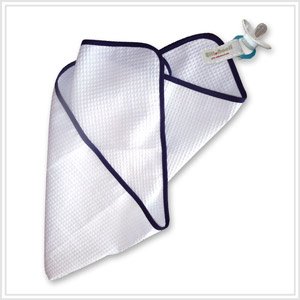
A mother whose baby has severe eczema created a blanket to help relieve her child’s skin irritation, and she gave me a blanket to try out. It is the Elli & Nooli Organic Cotton Pique Blanket (http://www.amazon.com/Loopiblanket-Organic-Blanket-Pacifire-Fastner/dp/B008MBMYZ8/ref=sr_1_2?s=baby-products&ie=UTF8&qid=1346005373&sr=1-2&keywords=elli+%26+nooli). 

I brought it to work to try with a few patients, and then brought it home to my toddler son. It is designed for infants, but since it is big enough to swaddle them comfortably, it is actually big enough (30” x 40”) to cover my toddler in bed (although he will soon outgrow it). This is now my son’s favorite blanket, and since giving it to him over a month ago, he insists on using it every night to sleep. He reports that it is “comfy”. The certified organic cotton means that it is less irritating than other fabrics, as well as being chemical-free and pesticide-free. The pique weave (tight weave forming raised mini squares all over) keeps air flowing under the blanket, and even allows some air exchange through the blanket. It keeps my child warm, without over-heating, so he is not sweating at night, despite living in a house with no air conditioner during a heat wave (for the past 2 weeks only, we are moving soon). Overall, I really like this blanket, and would recommend it for babies with sensitive skin.

Please note that although this post mentions many brands (e.g. Dove, Cetaphil, Aquaphor, Elli & Nooli), this is NOT a sponsored post, and I have no financial stake in any of these companies.

Thursday, August 9, 2012

Coughs, Colds, and Croup


Even though it's a beautiful summer here in Southern California, we are still seeing some coughs, colds, and croup, so here are my tips to help keep your family comfortable as they clear their viruses:

Helping a child with nose congestion:
-          Use a nasal saline mist (such as Little Noses nasal saline mist) to spray moisture into each nostril and help clear her out. I like the mists more than the drops because you can hold the canister right below her nose and spray it in, without touching the canister to the actual nose, and without sticking anything directly up the nose. These are also sterile, so you don't have to worry about the water source.
-          Use a humidifier. Only put distilled or sterile water into it (not tap water). Clean it at least every 3 days. Do NOT use the menthol or eucalyptus discs/drops that come with some humidifiers.
-          If she suffers from allergies and is over age 4, you can use an over the counter antihistamine to help decongest her (e.g. children’s Benadryl). Under age 4: ask your pediatrician about these. Do NOT use the over the counter medications known as “decongestants” or “medicated cough syrups”, as these have been shown to have more risks than benefits in children under age 6 years old.
-          If he is very congested you can steam up your bathroom and sit in the bathroom with your child. Make sure the air is okay and the child does not have any access to the hot water. Never leave a child alone in the steam!
-    If you want to, you can use a vapor rub on the feet or chest of a child. It has not been proven to help or hurt. However, do not let the rub get near her nose or mouth! Vapor rub placed under the nose has been reported to cause wheezing in some children, and it is dangerous to ingest. Call poison control if your child eats any of this, or gets it in their eye 1-800-222-1222 (an important number to keep in your cell phone for emergencies).
-          Children under age 2 years usually can not blow their noses, so help decongest them (e.g. get the boogies out) by using a Nose Frida (http://www.fridababy.com/) which is a device you put in the nostril and use to literally suck the snot out. Sounds gross, but there is a filter (which needs to be changed every day) which prevents you from getting any snot in your mouth. You can do this before feeds and before sleep, or just as needed to clear out the mucus in your baby’s nose. I like this better than traditional nasal aspirators because it’s much easier to clean, is difficult to put it too far into the baby’s nose, and it gets a lot more of the snot out. The key to good suction is to hold the other nostril closed, when you suck out boogers from the first nostril (should take less than 1 second).

NoseFrida the Snotsucker!
The Snot Sucker
Helping a child with a “wet” or “phlegmy” cough:
-          Do all of the above for nasal congestion plus the following:
-          Have her sleep propped up at 30 degrees so the mucus drains easily (if over 1 year of age).
-          Give children over age 1 year a big spoonful of honey twice a day. The honey has now been shown to help relieve cough symptoms in kids & help them sleep, in 2 published randomized control trials (scientific studies). The honey they used was NOT "raw", which can have dangerous bacteria in it.
-     Warm liquids, such as chamomile (caffeine-free) tea and lemon, or chicken soup, can help people feel better. 
-          Zinc may help shorten colds and soothe sore throats, but this has not been proven conclusively. You can get this in some non-medicated cough syrups, such as Zarbees (for over age 1 since it also contains honey), or in zinc lollipops (over age 2, observing child while they eat them) at CVS (I haven’t seen them anyplace else- let us know in the comments if you find them in other places). If he is over age 7 years you can give him the zinc cough drops that are available at all pharmacies.

Helping a child with a dry, barking, or croupy cough:
-          Do all of the above for nasal congestion & wet coughs plus the following:
-          Use a cool-mist humidifier. Use distilled/sterile water in it. Clean it at least every 3 days by rinsing out the water tank with distilled vinegar and then washing that out.
-          If the child is having a coughing fit, or breathing like Darth Vader, take him for a walk outside in the cool air, or hold him in front of an open freezer for a few minutes, to reduce the swelling in his throat. If that is not helping, call your pediatrician for immediate medical advice, or call 911 if he is actually having trouble breathing.

Check out other mom pediatrician blogs on the topic, such as this one from Dr. Stuppy:
http://pediatricpartners.blogspot.com/2013/12/but-snot-is-green-or-how-can-we-treat.html

Other Important Stuff:
-          If your child is wheezing, noisy breathing, breathing hard, breathing quickly, breathing with flared nostrils, or other signs/symptoms not mentioned, please call your pediatrician or 911, or take them to the ER immediately. This information is not intended to act as a substitution for speaking to your physician or using common sense!
-          If your child is breathing so hard that they have trouble walking or talking, or if their lips or fingernails turn blue, please call 911 for immediate medical assistance.

-          Some of the products listed above can be found on my pinterest health board: http://pinterest.com/motek42/kids-health/. I have not been paid to review any of these products and I do not get money from their sales- I am just letting you know what has worked in my experience.

Saturday, April 28, 2012

Traveling with Children

Fortunately for us modern moms and dads, anywhere we want to go is just a plane, train, or automobile ride away. Despite the conveniences of modern transit, traveling with children remains a difficult endeavor. Here are a few tips to make your journey a little smoother:

1) Know your rights.
This sounds funny, but a lot has recently changed in U.S.A. airport security rules. For example children under 12 do not need to remove their shoes during screening. According to the TSA's website, you may carry as much juice and milk for toddlers as you "need until you reach your destination". The precise definition of how much you need varies by who is screening you at security.  During one trip with my then 1 year old, the security agent at LAX insisted that 3 small juice boxes was too much for a 5 hour flight, and threw all of our drinks away. I did not know enough to argue and instead I spent $$$ buying some non-organic, non-dilute juice for my child at the airport :( This also brings up the point to remember to be flexible, and give your self extra time for the unexpected.
For the latest information, check out the government's website:
http://www.tsa.gov/travelers/airtravel/children/index.shtm

2) Know your company.
Certain airlines and hotel chains are better at hosting children than others. Conversely, some airlines have recently banned children from first class on their flights, so don't expect an upgrade (or even friendly service) on those airlines. Malaysia Airlines is going to institute a "child free zone" even in their economy cabin on some flights. In general, European and Asian companies have been known to be friendlier to children on flights than USA airlines, often providing coloring books, special snacks, small toys, and other treats for families. Some airlines offer pre-boarding for families with infants and toddlers, while others have none. This may be more annoying than you think. When traveling with our then 2 year old, we had to wait until first class, business class, and everyone with a silver/gold card from the airline boarded (more than half of the passengers) before we were allowed to get on with a toddler, car seat, and hand luggage. Trying to get past the tiny aisle with people everywhere and a large car seat was not fun, and I think it disturbed the other passengers as well. Allowing us to board early, install the car seat and settle in would have prevented a lot of hassle for everyone. However, when we got to our destination we stayed at a hotel that provided us with squeaky bath toys and other amenities in the room that made us feel like family.
Here is a recent article from yahoo on the most family friendly airlines:
http://travel.yahoo.com/ideas/best-airlines-for-families.html

3) More tips just for flying with children:
- Try and book a flight with as few stops as possible, as take-off, landing, and boarding are the toughest times.

- Make sure you have assigned seats together in advance. Many companies have been separating families on flights, and then you rely on your fellow passengers to switch seats so you can sit together.

- I take our car seat when flying with my son, to make sure he is strapped in securely during our flight. This also ensures that he has a safe car seat for automobile travel when we arrive at our destination. It is also easier for him to fall asleep during the flight in his car seat, and more difficult for him to annoy other passengers by kicking them or climbing on the chairs. We use a GoGo Kidz Travelmate to turn the car seat into a stroller at the airport.

To avoid pain from the changes in pressure in the ear during flights, teenagers and adults can chew gum or drink water to encourage swallowing, and thereby open up the eustachian tubes in their ears to relieve the pressure. For babies the best way to do this is breast (or formula) feeding. Breast (or formula) feeding has the added bonus of providing sugar to the infant, which is a natural pain reliever. For toddlers, diluted juice in a straw cup works well. Older children can suck on lollipops to get them swallowing (and happy and distracted by candy). Nasal sprays can also help relieve congestion and prevent pain during the flight, but speak to your pediatrician about this (salt water sprays can help babies with stuffy noses, while kids with ear infections or sinus problems may need a prescription nasal spray). If all this ear tube talk is confusing, check out the ear anatomy pics here:
http://pinterest.com/motek42/ear-infections/

- I recommend waiting as long as possible before flying with infants. The younger an infant is, the less developed their immune system, and the more likely they are to get sick. The air on airplanes is re-circulated so it is very easy to pick up germs from other travelers, even ones who are seated far away from you. Infants younger than 2 months old who catch an illness with fever may have to undergo extensive testing, including blood, urine, and spinal fluid exams if they get sick. I know this is not possible for all families, but waiting until your infant is 9 months or older can save you a lot of hassle and illness later on. In addition, the USA is currently experiencing a surge in measles cases, most of which can be traced to foreign travel- see these links for more information:
http://www.reuters.com/article/2012/04/19/usa-health-measles-idUSL2E8FJDSD20120419
http://wwwnc.cdc.gov/travel/page/measles-for-air-travelers.htm
And don't forget to check the CDC website, and make an appointment with your pediatrician at least 2 months prior to any foreign travel, so you can get medications and vaccinations for your trip.

4) Have your bags packed with items that will keep your child calm, quiet and comfortable. 
I prefer small, light items. If you are used to distracting your child with your phone or other electronic items, keep in mind that you will not be able to use them on take-off or landing, and they might run out of batteries on long car trips, so make sure to pack low-tech items as well. I recommend packing a carry-on or car bag with:
  • baby wipes (good for cleaning up messes for kids of all ages)
  • snacks
  • your own sippy cups or bottles
  • four more diapers than you think you need
  • several different sizes of ziplock bags (for messes, soiled clothes, soiled diapers, and they are just generally handy to have)
  • a medical bag (children's acetaminophen, children's ibuprofen, children's benadryl, bandaids)
  • sunscreen (the sun through a car's windows can burn a child, and then sun through a plane's window has more radiation than down on the ground, so slather yourself and your child with sunscreen to avoid sunburns and -much later- skin cancer)
  • lollipops for age 4 and above
  • extra clothes (even for older children, as it's easy to get spilled-on during a flight or car trip, and you never know if, when, or where you'll get stuck)
  • books
  • re-usable stickers
  • dry-erase crayons and board
  • a soft blanket
  • your child's lovey (favorite blankey, stuffed animal, or other comfort item). 
I've linked to a few of these items, as well as book suggestions, on pinterest:
http://pinterest.com/motek42/traveling-with-children/

This blog has many more great travel tips, and this link is for a funny story illustration why you shouldn't feel bad about that huge carry on with all of the extra supplies:
http://eatpackgo.com/pack/pack-diaper-ninja/

Traveling with children is a lot more stressful then traveling alone, but with patience, planning, and a large bag it can be a fabulous adventure.

Have any good tips or links of your own? Please tell us in the comments!


(photo of my son in his car seat, looking out of the airplane window, photo taken by me 2009 (c) )

Wednesday, February 22, 2012

Interviewing a Pediatrician

Recently, one of my friends asked me what questions she should ask when interviewing a prospective pediatrician, so I thought I'd share my answer with everyone:

1) What insurance do you take?
Of course, this is only important if you're using insurance. I know several families now that have health insurance for emergencies, but pay for general health maintenance out of their own pockets. This reduces their overall medical expenses (because they have a cheap insurance plan, only for emergencies), and allows them to see whatever doctor they like. These families usually use free clinics for vaccinations, or pay out of pocket. This only works if your family is healthy. If you choose the latter option, ask about visit prices instead.

2) What hours is the office open for well visits? For sick visits? When is your chosen primary pediatrician actually in the office during the week?
Keep in mind that the smaller the office, the less hours they are usually open. So if you want to do well visits at night or on weekends, you will probably have to go with a very large practice, and may be seeing a different doctor (or nurse practitioner) each time.

3) Who covers for your physician when they are not in the office, not on call at night, or they are on vacation?
For night call, is the person on the phone a physician from your practice, a physician from another practice, or a physician extender (NP or PA) or nurse?

4) Do you use electronic medical records?
These can reduce errors, and allow the physician on call (if they are a doctor from the same practice) to access your chart at night and on weekends, if needed.

5) Can I always get a same day sick visit appointment?

6) Who answers regular questions by phone during the day? What I mean by this one is, does your pediatrician call you back if it is not urgent? Does a nurse handle most questions about illnesses on the phone? Does another physician answer the phone when your physician is not available?

7) Are there any physician extenders (nurse practitioners or physician assistants)? Are they the ones to see you for same-day sick visits or phone calls, or will your physician or their partner see you?

8) Are there separate sick and well waiting rooms? Are there separate sick and well exam rooms?
This reduces the chance of your baby being exposed to a virus

9) What is your vaccine policy?
If the physician allows un-vaccinated children in their practice, consider that your baby (who is too young to be vaccinated for certain diseases) may be exposed to somebody in the waiting room with measles, chicken pox, etc...

10) How often do you see the baby for child for regular check-ups?
This can actually vary quite a bit between pediatricians for the first 3 years of a child's life. After that, your child is seen for an annual well check every year.

11) Do you have a website? Do you use email to communicate with patients?

12) What hospitals do you cover? Will your chosen primary physician be the one to see your baby everyday in the hospital (when they are born and if they are admitted later) or will one of the covering physicians see them?

13) What kind of parenting resources can you offer?

14) Where is the best place to park or closest public transportation stop?
I have found (at least in big cities, such as LA and NY), that the best place to park for my doctor appointments is often somewhere other than the valet parking in the medical building. The website or administrative assistants at your pediatrician office should be able to tell you the best (free) place to work, as well as help you get there by public transportation, if that's your preferred mode of transport.

That's all I can think of for now, but please leave your tips in the comments section!
[My son is too young to be your pediatrician right now, but isn't he cute? ;) (c) ]

Tuesday, November 29, 2011

A Spoon-full of Sugar Helps the Medicine Go Down

Lots of parents have trouble getting their children to take medicine, so here are some tips to help:

Some techniques to help medicine go down easier:

Marry Poppins was right- a spoon-full of sugar helps the medicine go down! More accurately, a spoon-full of chocolate syrup will cover up the taste of most yucky medications. Apple sauce and yogurt are other common foods used to mask bad tastes. Many medications can be made to taste like your child's favorite flavor by the pharmacist before you even pick it up, so ask about this when you submit your prescription. Some medications come in "orally dissolving tablets" which kids (age 3 and older) can put in their mouth and they will dissolve without having to chew or swallow.

Liquid meds are often easiest to give to babies with a syringe (a tube that looks like shot, but does NOT have a needle on it), which you can get at any pharmacy, baby store, or from your physician. Squirt small amounts of medication into your baby's cheek and they'll usually swallow it. Don't squirt it directly onto their tongue or into the back of their throat, as this can lead to gagging. Follow-up with breast milk or formula (whatever they normally drink), before giving the next part of the dose. Alternatively, you can put the liquid medication in a bottle nipple along with a little breast milk/formula, and have them suck directly from the nipple, without the bottle attached. I do not recommend mixing the medication in a whole bottle, unless you know the baby will take the whole thing regardless of taste.

Most baby stores also sell special devices to help kids swallow medications,such as something that looks like a bottle, but keeps the medication separate, so you know exactly how much the child takes. I do not recommend giving children medications with droppers, because it's difficult to measure the amount you're giving, difficult to get all of the medication out of the dropper, and difficult to clean and dry the dropper fully between each use.

Learning how to swallow pills:

Once your child is ready to swallow pills (often by age 5!), it's a great help to teach them how, since many medications are easier to take in pill form, the older they get, the bigger the dose, and some medications are not available in liquid/ chewable form. Starting young can also be beneficial in preventing anxiety associated with swallowing pills. Adolescents and adults often have trouble swallowing pills because they fear that the pill will get stuck in their throats. Relaxation techniques and deep breathing can help. Looking in a mirror, sticking your tongue out, and saying "aaah" out loud (this lifts the palate so you can see your throat), can help people see that their throat is much bigger then the pill, and ease some of the anxiety.

The first step in learning how to swallow a pill is to practice with something that is NOT medication. I recommend starting with small, smooth, round candies (such as mini m&m's), and progressing to slightly larger candies (such as regular m&m's). People with anxiety may want to start with tiny candies, such as sprinkles. Other people prefer to start with tiny bread balls (made from mooshing a tiny piece of bread between your fingers), and go progressively bigger, since the bread dissolves easily in the throat. You will also need a big glass of water, juice, or carbonated beverage (such as sparkling juice, which the pill can float on).

Younger kids can be told to just try swallowing the candy without chewing, because they are often successful without thinking about it. Older children, or those without a natural tendency to swallowing whole pieces, can start by visualizing the item floating down their throat on water, like a little boat. They should start by making sure the mouth is moist, by salivating or taking a sip of their drink. Nest place the candy as far back on the tongue as possible, using the teeth to scrape the candy to the back of the tongue (a mirror helps some people see how far back it is). Then take a big gulp of the liquid, which should float the candy and allow it to be swallowed, just as you would usually swallow any regular drink. Some children will swallow the candy (and later pills) more easily by drinking the liquid through a straw.

When it comes to taking real medicine, some people hide their pills in mini-marshmallows, which are slippery when wet, and therefore easier to swallow. I recommend trying this without medication first, since these are bigger then most pills. You can also try covering the pills in chocolate syrup, applesauce, yogurt, or jam (but see the warnings below before trying that).

I suggest experimenting with these techniques in a relaxed environment until you find something that works for you.

Warnings:

These techniques are for generally healthy children, with normal anatomy and mentation! They should not be used for children with any anatomical abnormalities, dysphagia (trouble swallowing regular foods or drinks), or any medical conditions that effect swallowing, the head/face, the GI system, or the neurological system.

All children should be supervised when practicing swallowing candies, and when taking ANY medication. NEVER tell your child that the medication is candy, as this can cause them to sneak some more when you're not looking (many medications these days actually do taste like candy). Always keep medications (over the counter and prescription) and vitamins/ supplements out of reach AND in a LOCKED container. Kids are good at climbing and getting into high cabinets, purses, closets, and other hiding places.

Please speak to your pharmacist (who is usually in the back of the store, who has spent at least 5 years in post-graduate university studies, getting a doctorate degree in pharmacy), about what you can take your medication with, and whether you can cut, crush, chew, or open the medication. Many medications should NOT be taken with grapefruit juice. Some medications should NOT be taken with anything dairy. Some pills can be crushed and mixed with foods, where as others can not. Your pharmacist and/ or physician are the best people to speak to before taking your medication with anything but water.

Good luck & feel free to leave your own tips & experiences below :)
My son loves taking medicines! (c) 2009

Thursday, September 15, 2011

About myself & the blogosphere


Hello everyone, I am excited to be joining the blogosphere. I have decided to start a blog in order to provide general pediatrics advice in a longer format than I usually have in clinic, as well as share my experiences as a mother. This information does not substitute speaking to your physician, and all opinions are my own and do not necessarily express the opinions of my employers. The following is my bio:

I  grew up in Los Angeles, California, graduating from the Hamilton High School Academy of Music. My mother is a pediatric rheumatologist, giving me some extra insight into how medicine has changed over the past 30 years.

The University of California at Berkeley is where I spent my under-grad, receiving my B.A. with honors, majoring in Inter-Disciplinary Studies, Environmental Science. I went on to get a Master’s degree in Regulatory Science from the University of Southern California School of Pharmacy, which led to a position in clinical research at Childrens Hospital Los Angeles. While working there  I realized research was not enough for me, and I wanted to be a doctor too. I love medicine because it allows me to be a scientist, teacher, and detective every day, as well as help the next generation of children grow up healthy.

I obtained my M.D. from the Ben-Gurion University Medical School for International Health in Collaboration with Columbia University Medical Center. I received the Dean’s Award for Outstanding Contribution to the Medical School for International Health.  The school not only has an outstanding emphasis on clinical skills, but also allowed me to work with diverse populations, including a very short time in Ethiopia, and a senior project with the Bedouin community.

My internship and residency in pediatrics was completed at Maria Fareri Children’s Hospital, Westchester Medical Center,  New York Medical College, where I was their American Academy of Pediatrics Delegate.  I am honored to have received the Pediatric Residency Leadership Award. I am a member of the American Academy of Pediatrics and the Los Angeles Pediatric Society. I am certified by the American Board of Pediatrics.

I am happy to have recently moved back to Los Angeles with my family. I am lucky to have a wonderful, supportive husband, and a beautiful toddler son, who teaches us something new each day.

I am now seeing patients at Roxbury Pediatrics in Beverly Hills, CA. You can check us out at http://www.roxburypediatrics.com/

Thank you for taking the time to read my thoughts!